
- 300+ sunny days/year = intense UV exposure that speeds up cataracts and macular degeneration.
- Low humidity, wind, and dust worsen dry eye disease.
- Cheap sunglasses can be worse than none at all (pupil dilation + unfiltered UV).
- Decades of desert living cause cumulative damage – but regular exams and proper protection make a difference.
- Modern lens implant technology can restore vision lost to cataracts.
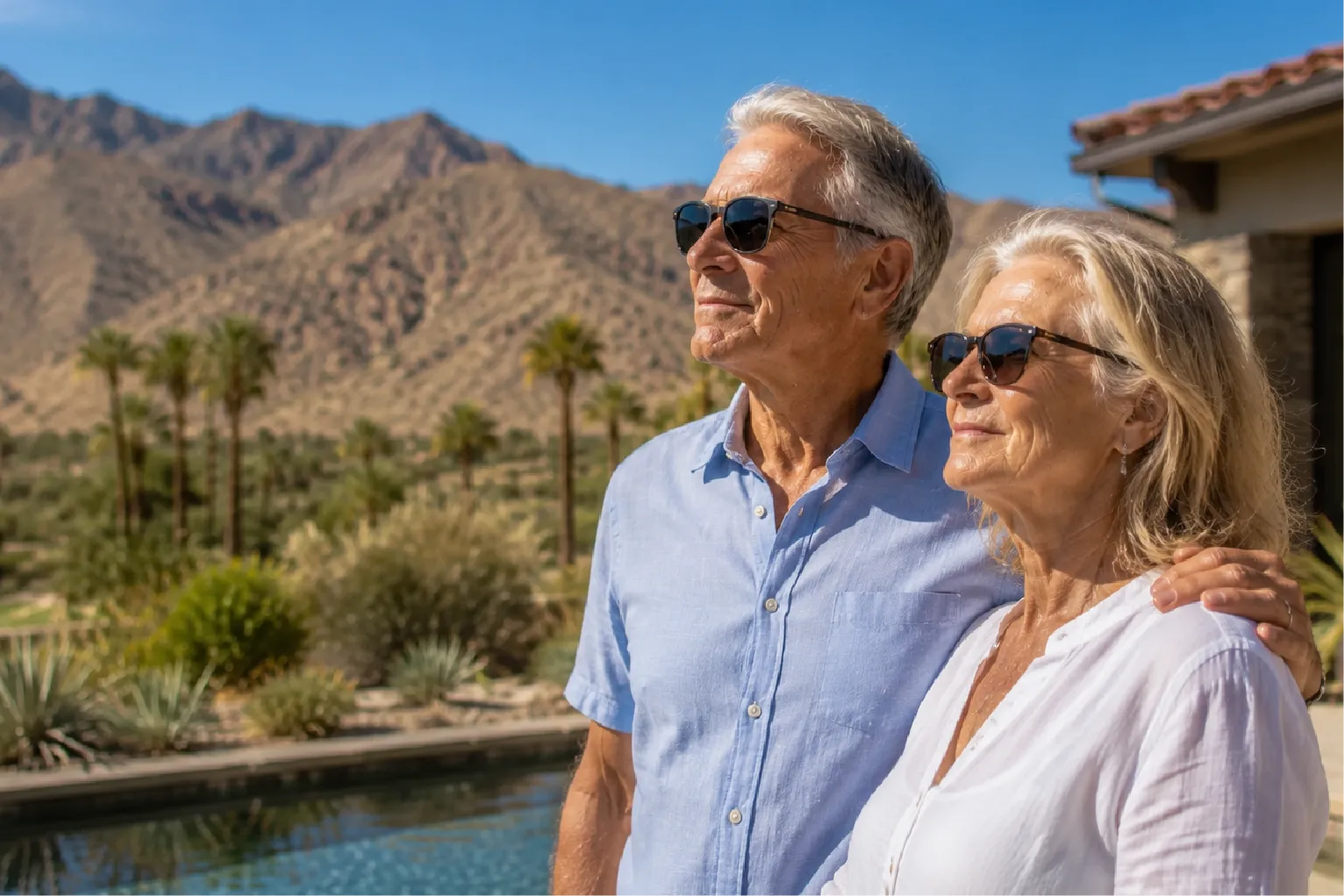
There is a specific moment every spring when Coachella Valley residents stop saying “it’s warm” and start saying “it’s hot.” It usually happens in late May. The morning rounds of golf shift earlier. The tennis matches move indoors. The pool becomes less of a luxury and more of a survival strategy.
What most people do not think about during this transition is what the desert is doing to their eyes.
The Desert Is Not Gentle on Your Vision
Living in the Coachella Valley means living under some of the most intense UV exposure in the country. More than 300 days of sunshine annually sounds beautiful in a real estate listing. For your eyes, it is a slow, cumulative challenge.
UV radiation accelerates the development of cataracts. It contributes to macular degeneration. It dries out the surface of the eye in ways that artificial tears can only partially address. And the desert adds its own complications: low humidity, wind, fine particulate dust, and the reflective glare off sand, concrete, and water.
In my practice at Desert Vision Center in Rancho Mirage, I see patients every week whose eye conditions have been shaped, quietly and persistently, by decades of desert living. Many of them are surprised to learn this. They assumed their vision changes were simply about getting older. Age plays a role, of course. But environment plays a larger one than most people realize.
Why “I Wear Sunglasses” Is Not Enough
Most desert residents wear sunglasses. That is a good start, but it is incomplete protection.
Not all sunglasses block UV effectively. Cheap lenses without proper UV coating can actually be worse than no sunglasses at all, because the tinted lens causes your pupil to dilate, letting in more unfiltered light. Wraparound styles that block peripheral light exposure make a meaningful difference, especially on the golf course or the tennis court where reflected UV hits from every angle.
Beyond sunglasses, there is the issue of cumulative damage that has already occurred. If you have lived in Palm Desert, Indian Wells, La Quinta, or anywhere in the Coachella Valley for 10, 20, or 30 years, your eyes have absorbed UV radiation that cannot be undone. The question becomes: what is the current state of your lenses, your retina, and your tear film? And what can be done now to protect what remains and optimize what is possible?
The Cataract Connection Most People Miss
Here is where it gets interesting. Many patients come to see me about cataracts without connecting the dots to their desert lifestyle. They have spent years outdoors: golfing at PGA West, playing pickleball in Palm Desert, walking the Art Smith Trail, swimming daily. They love their active desert life. They have also, without realizing it, accelerated the very condition they are now dealing with.
This is not a reason for guilt. It is a reason for awareness. Cataracts are treatable. Modern lens implant technology can restore vision in ways that were not possible even five years ago. But understanding the “why” behind your cataracts changes how you approach the solution.
A patient who understands that their environment has played a role tends to make more informed decisions about their lens implant selection, their post-surgical eye protection habits, and their long-term follow-up care. They become better partners in their own outcomes.
What I Tell My Desert Patients
Three things matter more here than almost anywhere else:
Comprehensive eye exams on a real schedule. Not when something feels wrong. Many of the conditions the desert accelerates, including cataracts, dry eye disease, and early macular changes, are most treatable when caught before symptoms become obvious.
UV protection that actually works. Quality sunglasses with full UV-A and UV-B blocking. A wide-brimmed hat. Awareness that UV exposure is happening even on cloudy days and especially near water or sand.
Honest conversations about your vision. If driving at night feels harder, if the golf ball is harder to track, if you are squinting more during your morning walk, those are signals worth discussing. Not in six months. Now.
Living Well in the Desert Starts With Seeing Well
The Coachella Valley attracts people who value an active, high-quality life. Golf, tennis, hiking, dining, art, community. All of it depends on vision more than most people consciously acknowledge. Protecting your eyes is not just a medical concern. It is a lifestyle concern, and it deserves the same attention you give to every other part of living well out here.
At Desert Vision Center, we specialize in helping Coachella Valley residents maintain the vision that makes their desert lifestyle possible. If you are ready to discuss cataract surgery options, we are here for the conversation. You can also contact Desert Vision Center to schedule a consultation.
Schedule a comprehensive eye exam at Desert Vision Center in Rancho Mirage
Book your exam today →
Or call us directly at 760-340-4700